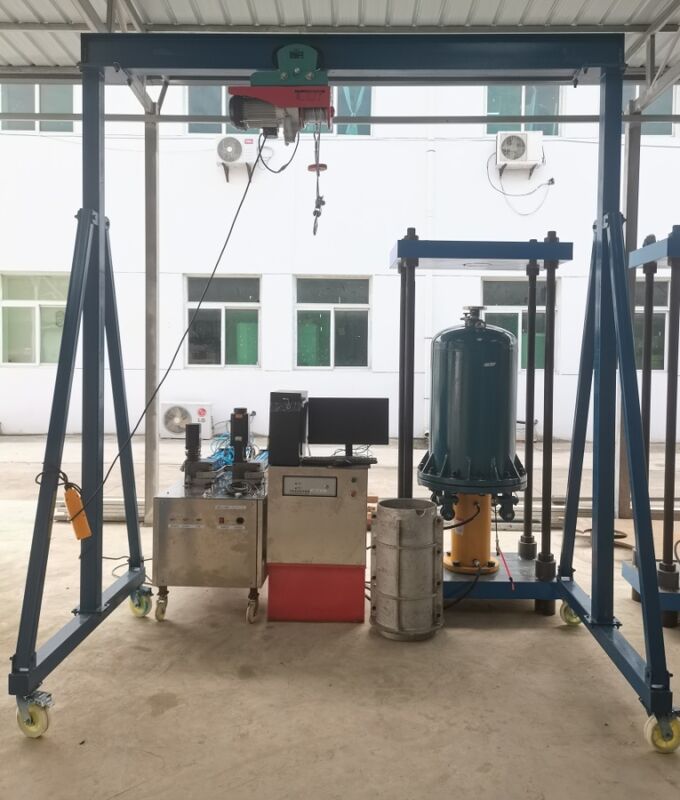
Test appllication:
Suitable for measurement based on the stress state and usage conditions of the soil based gravel foundation The shear strength index parameters of coarse-grained soil with a diameter of 60mm.
A method for determining the shear strength of soil typically involves applying pressure to 3-4 cylindrical specimens at different constant surrounding pressures (i.e., small principal stress σ 3), resulting in a stress difference (σ 1- σ 3), and shearing until failure. Then, based on the Mohr Coulomb theory, the shear strength parameters, triaxial creep, triaxial permeability, lateral compression coefficient, unconfined compression strength test, and strain controlled loading consolidation test are obtained.
Determine the total shear strength parameters and effective shear strength parameters of fine-grained soil and sandy soil, and divide them into three types of tests based on different drainage conditions: unconsolidated undrained shear (UU), consolidated undrained shear (CU or UU), and consolidated drained shear (CD) (pore water pressure dissipation test), and (multi-stage loading triaxial compression of one specimen).
The pressure chamber can be equipped with built-in or external sensors (built-in sensors reduce frictional resistance and are not affected by confining pressure)
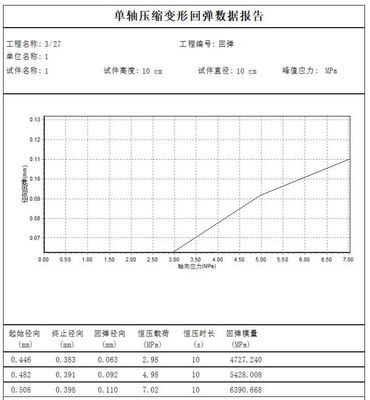
Optional functions: 1. Machine coefficient, automatic control of surrounding pressure during shearing process, and can also obtain the initial tangent modulus and tangent modulus of any segment within the strain range. 2. The shear modulus remains constant at (σ 1+2 σ 3)/3 throughout the experimental shear process. 3. Elastic modulus, automatic control of axial repeated loading, unloading, and control error ± 1KPa, using real-time cyclic control technology to automatically correct axial deformation errors during the pressure and unloading conversion process of the pressure machine. 4. It can also be used for various special tests such as flow penetration tests.
The unconsolidated undrained (UU) test does not allow the specimen to drain during the process of applying surrounding pressure and increasing axial pressure until failure occurs.
Consolidation undrained (CU or UU) refers to the process of first draining and consolidating a specimen under a certain surrounding pressure, and then increasing axial pressure until failure while maintaining undrained conditions.
Consolidation drainage (CD) is the process of draining and consolidating a specimen under a certain surrounding pressure, and then increasing the axial pressure until the specimen is fully drained and fails.
Cylindrical specimens generate pore water pressure dissipation coefficient, dissipation percentage, and pore pressure coefficient under ambient pressure or axial pressure under K0 conditions (applicable to intact cohesive soils with saturation greater than 85% and compacted cohesive soils with moisture content greater than. optimal moisture content).
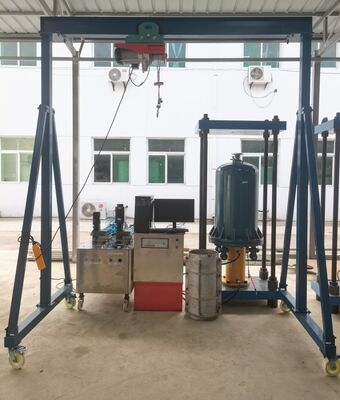
The important components of the stress-strain triaxial apparatus include servo motor, controller, software, sensors, confining pressure control system, back pressure control system, pore pressure control system, pressure chamber water injection and drainage system, main unit, and sample preparation accessories.
Technical parameters
1. Axial ultimate load: 600kN force sensor computer-controlled display
2. Axial deformation: 0-120mm ± 0.01mm displacement sensor computer-controlled display
3. Strain rate: 0.01-4.5mm/min with stepless speed regulation and adjustable settings
4. Stress rate: 10N~30KN/S, adjustable arbitrarily
5. Constant force is set according to the required settings; Emergency shutdown can be set.
6. Surrounding pressure: 0-3MPa or 4MPa ± 0.1kPa LCD display computer control
7. Counter pressure, pore pressure, saturation pressure: 0-2MPa ± 0.1kPa LCD display computer control
8. Consolidation drainage, shear drainage (volume change) accuracy 0.1ml LCD display computer control
9. Pressure chamber: φ 300 × 600mm
10. Lifting stroke: 0-200mm
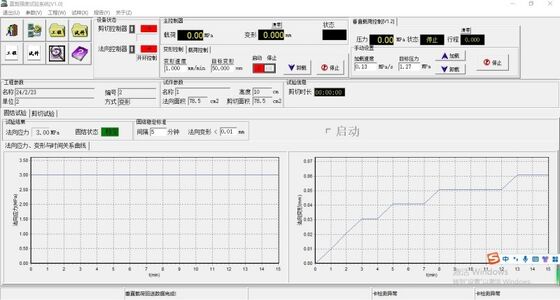
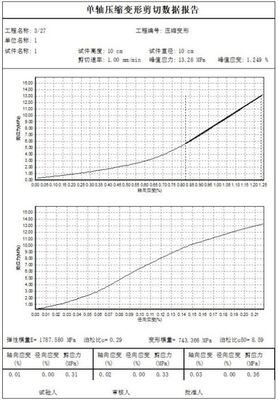
11. Windows data acquisition and processing software, supports networks, is compatible with existing computer systems, is easy to use, and does not require an additional data acquisition system for the entire machine. The computer is fully automated and the software collects and processes data, and can export data and graphics.
12. LCD display, keyboard input, displaying axial pressure, axial deformation, confining pressure, back pressure, pore pressure, volume change, speed, real-time clock calendar display, etc'
13. The three-axis host adopts a steel frame structure, uses a * * motor for full range stepless speed regulation, and has upper and lower axial protection, with automatic shutdown.
14. Features: The hydraulic system for confining pressure and backpressure control adopts a "precision digital piston", which can not only apply confining pressure and backpressure, but also measure body deformation and drainage, with a resolution of 1mm3 (cubic millimeters). Even if backpressure is applied, there is no need for measuring tubes and body deformation tubes, no need for drainage and body deformation sensors, no need for manual reading and recording operations. The pipeline adopts quick couplings, the container automatically injects water, and the drainage device is easy to operate. It can produce various outputs such as constant pressure and constant rate, cyclic pressure and volume changes, linear changes over time, etc. as required.

About this supplier
Xi an Zealchon Electronic Technology Co ., Ltd With more than 15 years of civil engineering background, located in new technology industry development zone in Xi'an, an ancient city in China. It covers an area of 7500 square meters of building area. We manufacture and supply testing instruments for civil engineering, geological survey, water conservancy and hydropower, roads and bridges, highways, railways and airports. We specialize in the production and sales of geotechnical testing instruments, asphalt and asphalt mixture testing instruments, cement and concrete testing instruments. Zealchon is engaged in manufacturing and supplying qualitative array of research and laboratory testing equipment. Zealchen specialize in civil engineering research and experimental apparatus; another is the semiconductor laser research and development.Our range includes research lab instruments, soil testing instruments, bitumen testing instruments, and cement& concrete testing equipment.
Packaging & shipping specifications
FAQs
Who are we?
We are based in Shaanxi, China, start from 2014, sell to Eastern Asia(30.00%), South Asia(30.00%), Mid East(15.00%), Western Europe(15.00%), Southern Europe(10.00%). There are total about 11-50 people in our office.
What can you buy from us?
Bitumen Testing, Material Testing, Aggregate Testing Machine, Soil Testing, Laboratory machine.
How can we guarantee quality?
Always a pre-production sample before mass production; Inspection and Calibration: technician do it strictly before shipment.