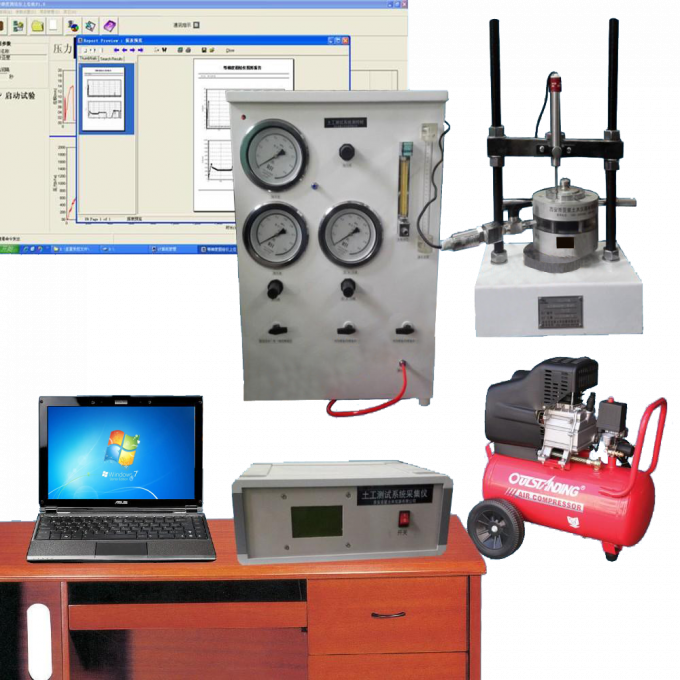
C157 Static Lateral Pressure Coefficient Tester for Soil lab testing
The static lateral pressure coefficient is the ratio of the lateral effective stress to the axial effective stress of the soil under the condition of no lateral deformation.
Use a piezometer to conduct a drained or undrained test to measure the lateral effective stress and axial effective stress, and calculate the static lateral pressure coefficient of the soil, which is suitable for saturated clay soil and sandy soil. Features of the instrument: Constant and step-by-step loading can be achieved through air pressure and water pressure. Special software can automatically collect and monitor displacement and pressure in real time. With various container devices, one machine can perform multiple tests.
The main components of the instrument:
The instrument is mainly composed of an air pump, measurement and control cabinet, air pressure reaction frame, displacement sensor, side pressure sensor, and computer software acquisition system, which can display and store data graphs of pore pressure, deformation, rebound, pore pressure and deformation, pore pressure and time. The data deformation graph, the data graph of deformation and time, the rebound graph of loading and unloading, the maximum value, minimum value, and average value of the data corresponding to the time. Supporting test device: K0 consolidation instrument. Computer software acquisition system: real-time acquisition and monitoring of displacement and lateral pressure changes.
Technical Parameters:
1. Axial loading: 0 ~ 10kN; constant loading according to the sample surface 2. Sample size of KO consolidation instrument: Φ61.8mm×40mm 3. Calibration sample block: inner diameter 61.8mm, height 100mm 3. Axial pressure gauge: 0~1MPa; resolution: 0.005MPa 4. Back pressure gauge: 0~1MPa; resolution: 0.005MPa 5. Back pressure: 0~500kPa ±0.01kPa 6. Side pressure transmitter: 0~1MPa ±0.01MPa 7. Axial displacement: 0~20mm ±0.01mm 8. Standard configuration: one sample, one side pressure, one deformation 9. Optionally make three samples, three side pressures and three deformations at the same time